


12 Mar “What we see depends on what we look for”

“Was Your Cardiac CT Scan really normal”
Screening for coronary artery disease with Cardiac CT is an evolving field, millions of people around the world have had screening scans. There are different scans and the technology is in evolution. It has been recommended since 2016 by NICE as the primary test for investigating Chest Pain, and there are now ongoing international studies for asymptomatic patients.
Cardiac CT scanning started in the 1990’s and initially looked at calcium build up in the arteries. Arthur Agatston developed a scoring system, the CAC score. which is used today in US guidelines to help recommend statin treatments, but it doesn’t tell the full story.
Coronary Artery Calcium Scan (CACS)

CT scanners have evolved to be faster and better; this has made imaging of the heart possible with reasonable X ray doses. Infusing a contrast media into the arm by an IV, helps visualise the coronary arteries that feed the heart muscle and the disease (atherosclerosis) affecting them. This is called a Coronary CT Angiogram (CCTA), and it gives much better information than the CAC scan as it looks at the inside of the artery and its wall.
CCTA with dye showing non calcified plaque
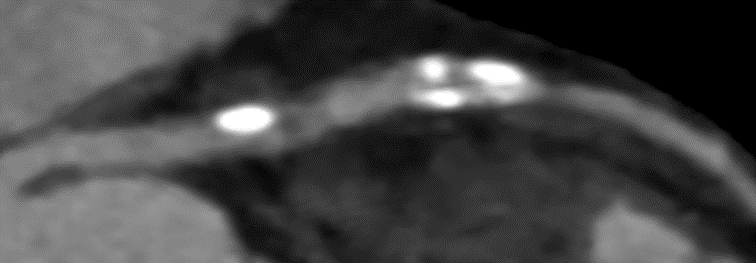
Atherosclerosis is the disease process that causes narrowing inside the coronary arteries with the build-up of fatty material (plaque). Heart attacks are caused by the sudden rupture of these plaques. Both atherosclerosis and plaque rupture are driven by inflammation. Simply put, inflammation is a measure of disease activity. Inflammation is a silent risk factor just as cholesterol or blood pressure that needs to be managed to lower risk of coronary artery disease.
Scientists at Oxford university have found a way of analysing standard CCTA images to detect inflammation, even before any sign of disease is visible in the arteries. Their research, published in the Lancet, showed that this technology is predictive of future cardiac events, and that patients with a seemingly “normal” scan may have high inflammation.

The CaRi-Heart® analysis, from a UK company called Caristo Diagnostics, is now available from Cotswold cardiology to give an even more accurate prediction of future risk from a standard CCTA scan. It may be particularly useful for people having scans between the age of 40-50 or those with seemingly “normal scans” to detect markers of future coronary artery disease even earlier.
By finding this previously hidden risk this will hopefully help people who could develop heart disease in later life by even earlier detection, allowing them the opportunity of preventative measures at an earlier stage, and avoiding them becoming patients.
Sorry, the comment form is closed at this time.